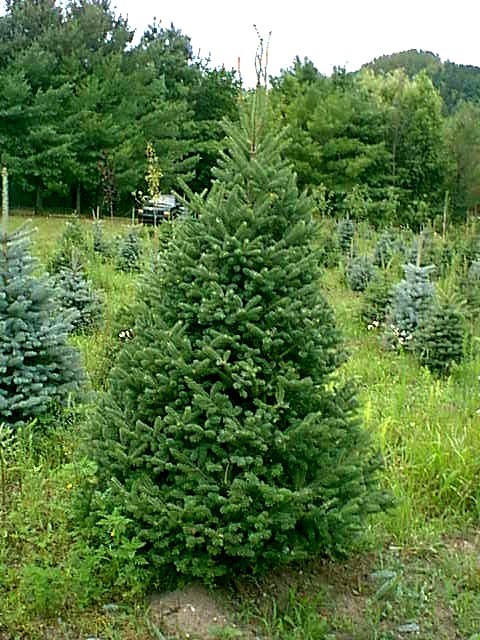
Leaves. The needles
of the balsam fir are a lustrous dark green above, aromatic,
pale beneath, narrow and straight, blunt, flat 1/2 to 1" long with a notched
tip. Scattered, spirally arranged in rows, on young balsam fir
extending from all sides of the branch, on old trees covering
the upper side of the branch.
Flowers. Balsam
fir flower in May, 1/4" long, male catkins.
Fruit. The cones of
the Balsam Fir are erect as in all true firs, 2-4" long and
1" wide, purple when new, browning with age and leaving a stem
as the seed fall off. The young cones are in my opinion a real
spring visual treat, be sure to look for them this June. The
seed are about 1/4" long it takes about 50,000 to make a pound.
Winter Buds. The
buds are small resinous and brown.
Bark. Mature trunks
on Balsam Fir is rough cinnamon-red, thin, scaly, at length
becoming gray, younger trees bark is smooth grayish and
resinous.
Wood. The wood is
light, soft, weak, coarse- grain with wide rings and lighter
colored sapwood, used locally as lumber but mainly pulp wood and
also box & crates and of course logs for cabins wood.
balsam fir wood weighs 25 pounds per cubic foot.
Pests. The balsam
wooly adelgid and spruce budworm are major pests. In the early
20th century the overcutting of the white pine forests in the
Midwest caused spruce and fir to take over the land that white
pine dominated. This in turn made fertile ground for the spruce
budworm which destroyed millions of cords of balsam fir. These can be
generally treated with an application of Sevin.
Distribution.
Balsam fir are
typically a cold climate tree. Balsam Fir is found from Maine to Michigan and south in the
higher elevations of the Appalachian mountains above 4,000 feet
in the south. I have found Balsam Fir growing on the top of
Brasstown Bald, the highest point in Georgia on our trip in
2007. Balsam fir is the only native fir of the northeastern
states. Can be seen growing from barren rock in it's native range.
In Michigan it is generally found in spruce, hemlock, fir
swamps.
Other. Fine
Christmas tree though the Fraser and Douglas fir are more in
demand. We have a balsam fir Christmas tree in our living room
and as of today ( Feb 10th ) the needles are still firmly
attached. I last watered it on December 31. We went to
California for a month and I left it up.....
The sap was once used to mount specimens on microscope
slides. The needles of balsam fir were once used in pillows to
add an aromatic flavor to ones sleep. We have beautiful Balsam
Fir here at the farm for U-Cut or We Cut Christmas tree sales.
Cultivars. hudsonia-
1-2' tall, rare.


 Balsam
Fir Abies balsamea Balm of Gilead
Balsam
Fir Abies balsamea Balm of Gilead